The Teachings of Wang Chong Yang
Wang embraced many of what he considered the better aspects of the three teachings which dominated China’s religious followings at the time – Daoism, Buddhism, and Confucianism – and incorporated them into the Quanzhen school. He moved away from the elaborate ceremonies, the writing of talismans, and the intricate visualisations that were central to the old Daoist traditions and put a greater emphasis on self cultivation through the practice of quiet sitting meditation. He identified closely with the simplicity and naturalness in Laozi’s Daode jing, as well as Zhuangzi’s teachings of spontaneity and non interference (wu wei). There are several other texts considered important in the Quanzhen school and these include the Clear and Tranquil Classic, the Yin Convergence Classic, and the Jade Emperor’s Mind Seal Classic.
The elements he took from Buddhism included their approach to karma and rebirth and, in particular, the Chan (Zen) teachings of the Heart Sutra and the Diamond Sutra. He also had great respect for the teachings of Confucius and encouraged his followers to study the Classic of Filial Piety, to help others, and do good deeds whenever they could. Wang considered the golden elixir to be our true nature. He said that helping others and being clear and tranquil contributes to developing this elixir. He advised that people wishing to cultivate their true nature should not seek fame, wealth, or profit, should eliminate worry and anger, and should abstain from sex, alcohol, and strong smelling vegetables (onion, garlic, etc.) He left behind fifteen principles for following the Dao which form the basis of the Quanzhen teachings.
Wang and his followers lived a very simple and ascetic life, surviving on only the bare necessities. They had intensive periods of meditation, and followed ascetic practices such as never laying down to sleep. Sometimes they would wander together from place to place, at other times they would live separately as hermits. Although the Quanzhen school adopted a temple lifestyle as it developed after Wang’s death, the path of simplicity that he advocated still remains a strong part of the tradition. To this day it is still common for priests to spend a period of two or three years “cloud wandering”, in which they travel the countryside, visiting temples and studying with different teachers. Those whose cultivation develops may also choose to spend time living as a hermit in one of the small shrines or caves that are found in the mountains of China.
By tradition the priests possess seven sacred objects: “The first object is the meditation cushion which tames the monsters of the mind. The second is the robe which subdues the mischievous mind. The third is the bowl which holds only purified (meatless) food. The fourth is a straw hat for protection against wind, rain, frost, and snow. The fifth is a horse-hair whisk or fan for sweeping away the dust of the mundane world. The sixth is a bag for carrying the sacred scriptures. The seventh is a staff for clearing the obstacles that block the clear wind and bright moon of the Tao.”
The priests will also apply the following cultivations in their daily life: “When walking, the gait should be like that of a crane and the body should move like an immortal floating with the winds. When sitting, the body should be still as a rock. When sleeping, it should be curved like a bow. When standing, it should be like a tall pine. Your body should be as flexible as a willow in the wind and as relaxed as the petals of a lotus.”
The Seven True Daoists of the North
Wang left seven accomplished disciples, six men and one woman. They all continued to spread the teachings of the Quanzhen sect and are called the Seven True Daoists of the North. Each one expressed the Quanzhen teachings in their own way, creating seven different lineages:
 The sect of Qiu Chuji is called Longmen (Dragon Gate)
The sect of Liu Chuxuan is called Suishan (Mount Sui)
The sect of Tan Chuduan is called Nanwu (Southern Void)
The sect of Ma Danyang is called Yuxian (Meeting the Immortals)
The sect of Hao Datong is called Huashan (Mount Hua)
The sect of Wang Yuyang is called Yushan (Mount Yu)
The sect of Sun Bu’er is called Qingjing (Clarity and Stillness)
Picture above: Wong Chongyang (1112-1170) teaching his Seven Disciples
Qiu Chuji and the Dragon Gate Sect
The largest of these is Qiu Chuji’s Dragon Gate sect. Following Wang’s death the seven disciples dispersed. Qiu Chuji continued to follow a quiet ascetic life, living in caves and begging for food.
He lived for several years in the Dragon Gate Cave and his sect is named after this place. It was here that Qiu began to develop his teachings, emphasizing Wang’s view that the three doctrines of Buddhism, Confucianism, and Daoism are complimentary and share a common origin. Later in his life he gained favor with the Jin emperor Shizong and then with the conquering Mongol ruler Chinggis Khan, who honored him with the title Spirit Immortal. With this recognition and support the Quanzhen school grew very quickly and Qiu encouraged the building of many Daoist temples, developing the structure for that way of life. He gained a large following, including many among the working class, and over the years the Dragon Gate sect spread to many parts of China becoming the main representative of the Quanzhen school. There is even a saying that “the Dragon Gate covers half the land.” Qiu spent the last few years of his life in Beijing living at a Daoist temple now known as the White Cloud Temple, and was buried there after his death. Since his time the White Cloud temple has been the seat and headquarters for both the Quanzhen and Dragon Gate sects, and continues to be so even today.
Master Wang
Master Wang who was born in wudangshan studied internal wudang kungfu throughout his life. In the 80’s, however, he felt the need to enlarge his knowledge about kungfu outside of wudang. On his travels he went to ma ny different places from north east china to canton in the very south.
Even when he focused on internal daoist kungfu, he has also lived at the shaolin temple for more than a whole year. At the shaolin temple he teach wudang kungfu and t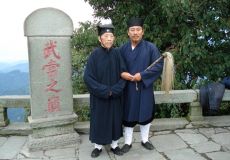 aijiquan and learned shaolin kungfu in return. After he came back to wudang in the early 90’s he followed the official call and started to teach wudang kungfu to the public.
In 1999 he opened his own school and founded the Wudangshan Chuanzhen Wushu Yuan (Wudang Dragongate Kungfu School) as well as the Exchange And Research Center Of Wudang Martial Arts Culture. Both institutes made a lot of efforts to spread wudang kungfu and preserve its traditional origin.
For more information about Wudang Dragon Gate please follow the link: http://wudang-dragongate.com/
 HOLISTIC SEEKER